Ceiling Fan Upgrades for San Antonio Mobile Homes: Improving Airflow and Comfort Without Overworking Your AC


Summers in San Antonio, Texas have a way of making you appreciate anything that can make a room feel cooler. Once temperatures climb into the 90s and stay there for days at a time, the air conditioner can seem like it is running constantly. In a mobile or manufactured home, keeping comfortable can be even more challenging because of the home’s layout, insulation, ceiling height, and available electrical capacity.
One relatively simple upgrade that can make a noticeable difference is a ceiling fan.
A ceiling fan does not actually lower the temperature of a room the way an air conditioner does. Instead, it moves air across the people in the room, creating a cooling effect that can make the space feel more comfortable. That means homeowners may be able to raise the thermostat slightly while still feeling comfortable, potentially reducing how hard the air conditioner has to work.
For mobile homeowners living in San Antonio, Texas, replacing an old, noisy, undersized, or poorly mounted ceiling fan can be a worthwhile electrical improvement. It can also be an opportunity to improve lighting, add convenient controls, and make better use of bedrooms, living rooms, porches, and patios.
Why Ceiling Fans Are Particularly Useful During San Antonio Summers
San Antonio’s climate puts plenty of demand on residential air-conditioning systems. During the hottest part of summer, an AC system may already be working hard to keep a home comfortable.
A ceiling fan gives homeowners another way to manage how a room feels.
When the fan moves air downward and across your skin, evaporation helps you feel cooler. This is why you can often sit comfortably beneath a running ceiling fan even though the actual room temperature has not changed.
That distinction is important. A ceiling fan is primarily a comfort tool, not a replacement for air conditioning.
There is also no reason to leave a ceiling fan running in an empty room simply because it is hot outside. Fans cool people, not rooms. Turning them off when nobody is using the room avoids wasting electricity.
In a mobile home, strategically placed fans can be especially helpful in bedrooms and living areas where people spend a lot of time. A properly sized and installed fan can improve air circulation without requiring the homeowner to crank down the thermostat.
Replacing an Outdated or Undersized Ceiling Fan
Many mobile and manufactured homes have ceiling fans that have been in place for years. Sometimes the fan still works, but that does not necessarily mean it is doing a good job.
Older fans may have:
- Noisy or inefficient motors
- Worn bearings
- Wobbly blades
- Limited speed settings
- Weak airflow
- Outdated lighting
- Pull chains that are inconvenient to reach
- Controls that combine the fan and light in an awkward way
An undersized fan can be another problem. A small fan may look appropriate in a large living room but fail to circulate enough air to make much difference.
Modern high-efficiency ceiling fans are available in a wide range of sizes and designs. Some use DC motors, which can provide efficient operation, multiple speed settings, and smooth performance. Others include integrated LED lighting, remotes, wall controls, or smart-home features.
The goal should not simply be to buy the newest fan at the home improvement store. The fan needs to be appropriate for the room and, just as importantly, appropriate for the electrical and structural conditions where it will be installed.
Choosing the Right Fan Size for Each Room
Bigger does not automatically mean better when choosing a ceiling fan.
The fan’s blade span should generally correspond to the size of the room. A fan that is too small may not move enough air, while an oversized fan can be unnecessary in a compact bedroom.
For example, a smaller bedroom may work well with a relatively compact ceiling fan, while a larger living room may benefit from a fan with a substantially larger blade span. Long or unusually shaped rooms may require additional consideration.
The ceiling height matters, too.
A standard installation may work well in a room with a conventional ceiling height, but manufactured homes can have different ceiling configurations. A fan that hangs too low could become a hazard, particularly in a bedroom or hallway.
Outdoor spaces require another layer of consideration. A covered porch or patio may need a fan specifically designed and rated for outdoor use.
Before purchasing a fan, measure the room and consider the ceiling height, furniture placement, existing electrical box, and intended use of the space.
Installing a Ceiling Fan Where a Light Fixture Already Exists
One of the most convenient ceiling-fan upgrades is replacing an existing ceiling light.
At first glance, this seems like a straightforward swap: remove the light fixture and attach the fan in its place.
That assumption can get homeowners into trouble.
A standard light-fixture electrical box is not necessarily designed to support the weight and movement of a ceiling fan. A fan creates dynamic forces as the motor operates and the blades rotate. The mounting system must be capable of supporting the fixture securely.
This is particularly important in a manufactured or mobile home, where the construction and framing can differ from a conventional site-built house.
Before installing a fan in place of a light fixture, the existing electrical box and mounting arrangement should be inspected. If the box is not fan-rated or the mounting system is inadequate, it may need to be replaced or reinforced using an appropriate fan-support system.
A ceiling fan that slowly begins to wobble is not something to ignore. Excessive movement can place additional stress on the mounting hardware and electrical connections.
Separating the Fan and Light Controls
Another common reason homeowners replace older ceiling fans is the lack of convenient control.
With some older installations, the fan and light may be operated through pull chains. That works, but it can be inconvenient when you are lying in bed or sitting across the room.
A newer installation can provide separate control of the fan and light.
For example, you might want the light turned on while the fan is off. At other times, you may want the fan running without the light. Separate controls make that much easier.
Depending on the existing wiring, a licensed electrician may be able to install a wall control that allows independent operation. The exact approach depends on the wiring already present and the capabilities of the new fan.
This is one reason it is worth thinking about controls before the installation begins rather than simply buying a fan and figuring out the controls afterward.
Wall Controls Versus Pull Chains
Pull chains are inexpensive and simple. They can also be perfectly functional.
But wall controls are often much more convenient, particularly in bedrooms.
Instead of reaching up to find a chain every time you want to change the fan speed, a wall control can put the adjustment at a normal switch location.
Some modern controls allow homeowners to select multiple fan speeds, operate the light independently, or dim compatible LED lighting.
There is no single best option for every mobile home. A homeowner who likes simplicity may prefer a basic wall control. Someone who wants maximum flexibility may prefer a remote or smart control.
Smart Ceiling Fan Controls and Remote Operation
Smart ceiling fans have also become more practical for homeowners who want more control over their homes.
Depending on the model, a smart ceiling fan may allow you to control the fan and light from a remote, smartphone app, or smart-home system.
Remote operation can be particularly useful when the fan is installed in a bedroom. You do not have to get out of bed to adjust the speed or turn the light off.
Some systems can also integrate with voice assistants or other smart-home equipment.
However, compatibility matters. Not every smart controller works with every fan or existing wiring configuration. If you are replacing an older fan and want smart controls, it is worth determining exactly what the new system requires before installation.
Don’t Assume the Existing Electrical Box Can Support a New Fan
This is one of the most important considerations for a ceiling-fan upgrade.
Modern fans can be heavier than older fixtures, especially models with large blades, integrated LED lighting, decorative housings, or substantial motors.
The electrical box is responsible for more than holding the wiring connections. It may also be part of the mechanical support system for the fixture.
A box that was suitable for a lightweight ceiling light may not be appropriate for a ceiling fan.
Before installation, an electrician can examine the existing box, mounting hardware, wiring, and surrounding structure to determine whether they are suitable for the new fan.
This step can be especially important in a manufactured home because the ceiling construction may not provide the same framing arrangement found in a traditional home.
The safest approach is to verify the mounting system rather than assuming the existing fixture location is automatically ready for a fan.
Choosing Outdoor Ceiling Fans for San Antonio Porches and Patios
A covered porch or patio can be one of the best places to add a ceiling fan in San Antonio.
Outdoor airflow can make a surprisingly large difference when you’re sitting outside on a hot afternoon or evening. A fan can help make a covered outdoor living space more comfortable without attempting to cool the entire area like an indoor room.
But an indoor ceiling fan should not automatically be installed outdoors.
Outdoor-rated fans are designed for the environmental conditions they are expected to encounter. Depending on the location, the appropriate fan may need to be damp-rated or wet-rated.
A covered patio that is protected from direct rain may have different requirements from an exposed outdoor location.
The electrical components and installation also need to be appropriate for the location. GFCI protection and weather-resistant electrical equipment may be important depending on the installation.
When in doubt, have the location evaluated before purchasing the fan.
Can a Handy Homeowner Install a Ceiling Fan as a DIY Project?
This is where a seemingly simple project can become more complicated.
A Texas homeowner who is comfortable assembling furniture and replacing basic fixtures may look at a ceiling fan and think, “How hard could it be?”
The mechanical assembly itself is usually not the biggest concern. The more important questions involve the electrical connections, mounting support, existing wiring, grounding, switching, and structural attachment.
Replacing a ceiling fan can involve working with electrical circuits and modifying the way a fixture is controlled. If the existing box is not rated for a fan, additional work may also be required.
For someone with substantial electrical experience, the project may be manageable. But being handy is not necessarily the same thing as being qualified to work on residential electrical wiring.
In Texas, homeowners should also understand the distinction between doing work themselves and hiring someone to perform electrical work. Local requirements and the circumstances of the installation can matter, so homeowners should verify applicable requirements before beginning electrical work.
For most homeowners who are not experienced with residential electrical installations, hiring a licensed electrician is the safer choice.
That is especially true for a manufactured home where the construction may not be immediately obvious and where an existing ceiling-light location may not have the structural support required for a fan.
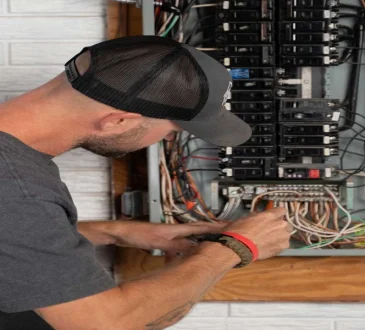
What a Texas Licensed Electrician Can Check During a Ceiling Fan Installation
A professional ceiling-fan installation is about more than connecting a few wires.
An experienced electrician can evaluate the existing installation and look for issues such as:
- Whether the electrical box is rated for a ceiling fan
- Whether the mounting hardware is secure
- Whether the existing wiring is suitable
- Whether the circuit and connections are in good condition
- Whether grounding is properly addressed
- Whether separate fan and light controls can be installed
- Whether a wall control is compatible with the fan
- Whether smart controls are appropriate
- Whether an outdoor fan requires additional weather-resistant equipment
- Whether the installation needs additional support
The electrician can also identify problems that might otherwise be hidden after the new fan is installed.
If the old fixture had loose connections, damaged wiring, an improperly supported box, or other issues, simply installing a new fan without addressing those problems does not solve the underlying concern.
A Practical Upgrade for San Antonio Mobile Homeowners
Ceiling fans may not be the most dramatic electrical upgrade you can make to a mobile or manufactured home, but they can be one of the most practical.
A properly sized fan can improve comfort in a bedroom or living room. A new installation can also give you better lighting, separate controls, remote operation, or smart-home compatibility. Outside, the right outdoor-rated fan can make a covered porch or patio much more usable during San Antonio’s warmer months.
And when an existing light fixture is being replaced, it is worth making sure the electrical box and mounting system can actually handle a ceiling fan before the new fixture goes up.
Mobile homeowners in San Antonio, Texas can trust Bebee Electric Plus when their residents need the services of an experienced licensed electrician for electrical projects that require professional attention. From ceiling-fan replacements to other residential electrical improvements, Bebee Electric Plus can help homeowners evaluate the existing installation and determine the appropriate approach for the home.
The biggest takeaway is simple: don’t judge a ceiling-fan installation by how easy the finished fixture looks.
The fan may only take up a small part of the ceiling, but behind it are electrical connections, mounting hardware, structural support, and safety considerations that need to be right. Getting those details checked before installation can help prevent wobbling fixtures, damaged wiring, unreliable controls, and other problems later.
For San Antonio, Texas homeowners looking to make their mobile or manufactured home more comfortable, a properly installed ceiling fan can be a smart improvement-especially when it is selected for the room, mounted correctly, and paired with controls that actually fit the way the household uses the space.